Risks Associated with Purchasing Pledged or Mortgaged Property
Purchasing pledged or mortgaged property can involve significant financial and legal risks, particularly where the underlying debt is settled informally, the required approval of the bank is not obtained, or the transaction is not properly documented and registered.
Informal Payments and the Risk of Fraud
A serious risk arises when a buyer gives money directly to the seller, without proper official documentation, for the purpose of settling the outstanding debt. After paying off the loan and having the property released from the pledge, the seller may disappear or refuse to complete the sale, leaving the buyer with little or no legal means of recovering the money.
Lack of the Creditor’s Approval
Pledged property generally cannot be transferred without the written consent of the creditor or mortgagee, such as a bank. A transaction carried out without the required consent may be considered legally invalid or may create serious difficulties in transferring clear title to the buyer.
Additional Encumbrances and Court Restrictions
There is also a risk that the property may be pledged as security for other debts or may be subject to a court order, attachment, enforcement restriction, or another legal encumbrance.
How Can Buyers Protect Themselves?
Involve the Bank
The purchase and sale should be conducted with the formal approval and, where appropriate, the direct involvement and supervision of the creditor bank.
Use a Secure Deposit or Escrow Arrangement
Payments should be formally documented and, where available, made directly through the bank or through a designated deposit/escrow account established within the relevant banking or notarial system, including the applicable ASAN Service or notarial procedures.
Ensure Proper Documentation
Under no circumstances should a buyer hand cash to the seller based solely on a handwritten receipt, verbal agreement, or informal arrangement. Every payment should be properly documented and legally traceable.
Buying a Property That Is Subject to a Loan or Mortgage
Problems can sometimes arise when buying and selling residential properties that are still subject to a bank loan—that is, properties pledged to a bank as security for a loan or acquired through mortgage financing. In many cases, buyers who wish to purchase such properties may become victims of fraud if the transaction is not handled through the proper legal and banking procedures.
For example, a buyer may give the seller money informally so that the seller can repay the outstanding bank loan and subsequently proceed with the sale. However, once the loan has been repaid and the property has been released from the bank’s security, the seller may disappear. The buyer may then find themselves in an extremely difficult position.
Even if the buyer takes legal action against the seller, proving that the money was previously handed over can be difficult if there is no official documentation confirming the payment.
According to the view of some experts, the safest way to avoid such situations is to ensure that all payments are made through formally documented procedures. Otherwise, if a legal dispute arises, the buyer may have no reliable evidence proving that the money was actually paid.
Importantly, the buyer does not necessarily have to hand the money intended to settle the bank debt directly to the seller. Subject to the bank’s approval, the parties may enter into a purchase and sale agreement and complete the transfer of the encumbered property in accordance with the applicable legal procedure.
The bank may also provide its consent to the notary for the sale of the apartment, subject to an arrangement under which the buyer assumes responsibility for the outstanding debt as the new owner. The law provides for mechanisms that allow a debt to be transferred from one party to another.
However, in practice, banks do not always make extensive use of this mechanism. Instead, they may require the existing borrower to repay the outstanding debt first and only then provide consent for the sale of the property.
What Is the Most Appropriate Approach?
In general, there are two main ways to purchase and sell a property that is still subject to a bank loan.
- Full Repayment Before the Sale
When the transaction is carried out on a cash basis, the bank may require the outstanding loan to be repaid before the sale is formally completed. Banks may prefer this approach because it allows them to ensure that the debt is fully settled before releasing the property from the mortgage or pledge.
In this case, the buyer first settles the outstanding debt with the bank and then pays the remaining amount requested by the seller, after which the property is transferred into the buyer’s name.
However, any amount paid directly to the seller should be made under a properly executed notarized agreement or other legally valid documentation. This is essential to protect the buyer in the event of a future dispute.
- Transfer of the Outstanding Loan to the Buyer
There are also circumstances in which the outstanding loan may be transferred to the buyer.
In such cases, the bank assesses the buyer to determine whether they meet its lending and repayment criteria. If the buyer satisfies the bank’s requirements, the outstanding loan may be transferred into the buyer’s name.
The agreement then establishes that the buyer becomes the new borrower and assumes responsibility for making the required loan payments. Once the loan has been fully repaid in accordance with the agreed terms, the buyer becomes the full legal owner of the property.
The Main Risks of Purchasing Pledged Property: International Practice
Based on international practice, the principal risks associated with purchasing pledged or mortgaged property generally include the following:
- Failure to Properly Remove the Pledge or Other Legal Restrictions
If the bank’s or another creditor’s security interest is not properly discharged after the sale, the buyer may continue to face legal restrictions or claims against the property.
- Hidden Debts and Liabilities
The property may be subject not only to a mortgage but also to unpaid taxes, utility bills, enforcement claims, court orders, attachments, or other financial and legal obligations that were not previously disclosed to the buyer.
- Ongoing or Future Legal Disputes
The borrower or another interested party may challenge the sale and initiate legal proceedings. This can delay the transfer of ownership and, in certain circumstances, place the entire transaction at risk.
- Failure to Obtain Vacant Possession
If the previous owner, a tenant, or another person continues to occupy the property, the buyer may face difficulties taking physical possession even after obtaining legal title.
- Incorrect Assessment of the Property’s True Market Value
A property being sold under pledge enforcement may appear to be available at a below-market price. However, once renovation costs, legal expenses, outstanding utility bills, possession-related costs, and other potential expenses are taken into account, the actual cost of the supposedly “cheap” purchase may be significantly higher.
The Most Important Principle
Before purchasing pledged or mortgaged property, buyers should not rely solely on the title deed or ownership certificate.
A comprehensive due diligence process should include verification of the property’s mortgage or pledge status, court and enforcement restrictions, outstanding debts and liabilities, registered occupants, and the legal basis and procedure for the proposed sale.
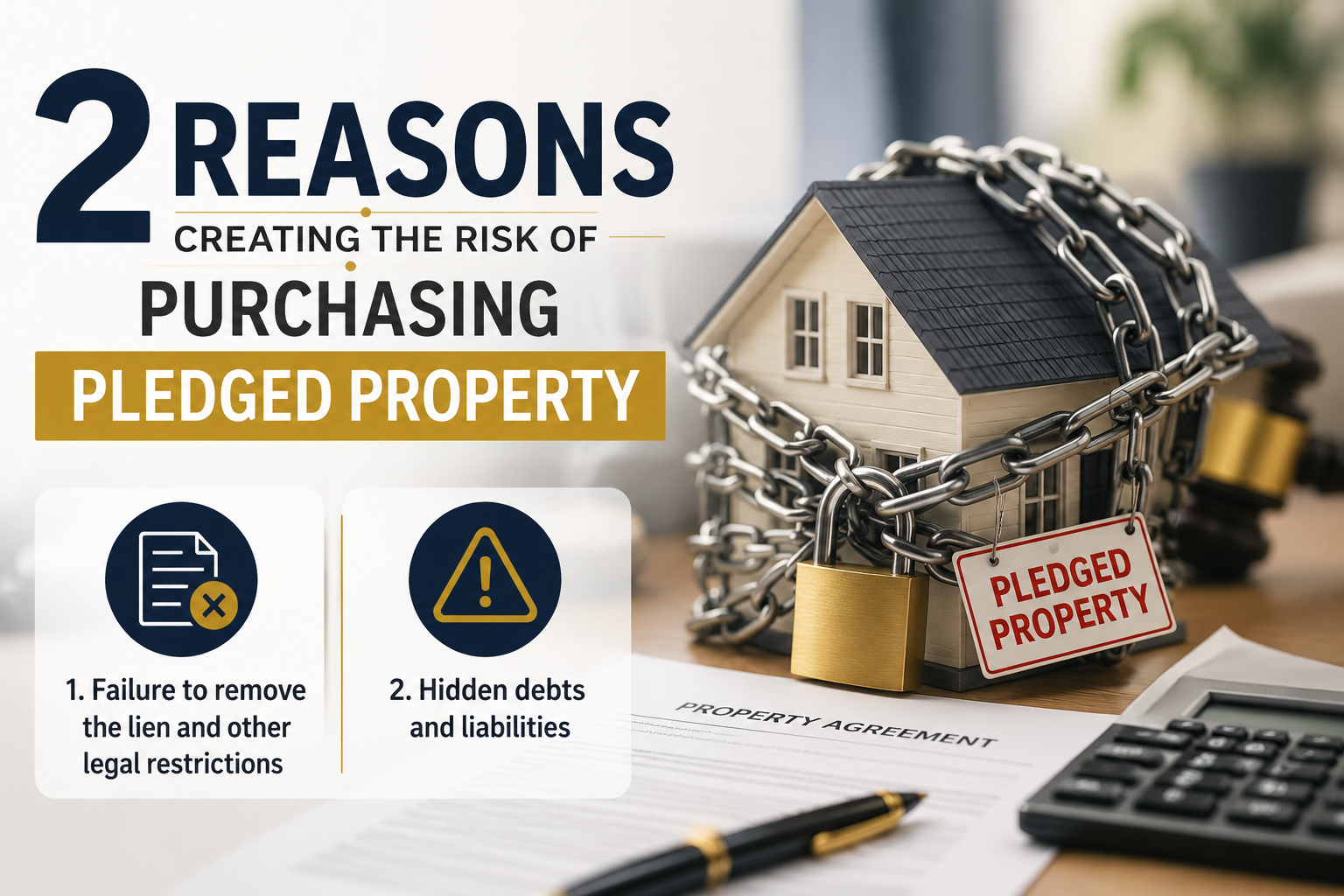
The Two Most Important Risks
If only two risks are to be highlighted, I would focus on the following:
- Failure to Fully Remove the Pledge and Other Legal Restrictions
This is arguably the most significant risk. Even after paying for the property, the buyer may still encounter an existing mortgage, attachment, court dispute, or claims from other creditors.
In other words, the buyer may have paid the purchase price, while the property is still not legally “clean” and free of encumbrances.
- Hidden Debts and Liabilities
The property may carry tax liabilities, unpaid utility bills, enforcement-related debts, or other financial obligations that the buyer was unaware of at the time of purchase.
If it has not been clearly established in advance who is responsible for settling these liabilities, the buyer may later face substantial unexpected costs.
The greatest risk when purchasing pledged property is that the property may not be legally free and clear of all encumbrances.
Leave a Reply